

© Jon Hawkins - Surrey Hills Photography
Heathland Connections
Joined-up thinking to connect Surrey's heathland
One of twelve landscape-scale Nature Recovery Projects delivered collaboratively across England, this Natural England funded, partnership-led initiative aimed to deliver habitat restoration by supporting landowners to effectively manage adjoining areas of remnant heathland under their care.
By working with landowners to enhance, restore, and connect heathland areas, we aim to create a network of wildlife-rich sites that preserves the distinctive character and productive landscape of Surrey.
In the longer-term, this work will make our heathlands more resilient to climate change and other pressures caused by human activity, as well as helping to reduce the financial and human costs of the climate and nature crisis. It is also an important step towards meeting the government-backed 30by30 goal, which aims to restore and protect 30 per cent of land and sea for nature in the UK and internationally by 2030.
Project partners
- National Trust (https://www.nationaltrust.org.uk)
- Land App (https://thelandapp.com)
- Surrey Hills National Landscape (https://surreyhills.org/visit/)
- Surrey County Council (https://www.surreycc.gov.uk)
- Waverley Borough Council (https://www.waverley.gov.uk)
- Amphibian and Reptile Conservation (https://www.arc-trust.org)
- RSPB (https://www.rspb.org.uk)
- Hampton Estate (https://www.hamptonestate.co.uk/)
Heathland Connections Network
Take a look at our map below to see our network of engaged landholdings. Each landholding forms a key part of this bigger picture and we feel it’s important for you to have an insight into how you fit in to the wider network. Please be aware that only those who have given permission to share their landholdings will appear on the map so this will not include everyone that engaged with the project.

© Tom Marshall
Take a look at the species we aim to support
In Surrey, we have some of the finest examples of lowland heathland in the UK which support a large range of species. These include the melodic Nightingale Luscinia megarhynchos, the elusive Adder Vipera berus and the cryptically camouflaged Grayling butterfly Hipparchia semele. However, these heathland reserves are fragmented and at risk, resulting in declining populations of these distinctive species.
Take a look at these maps which demonstrate just how important it is that we preserve and connect up these fragments of habitat. Species records shown within the maps were obtained from the Surrey Biodiversity Information Centre and from recent citizen science surveys.
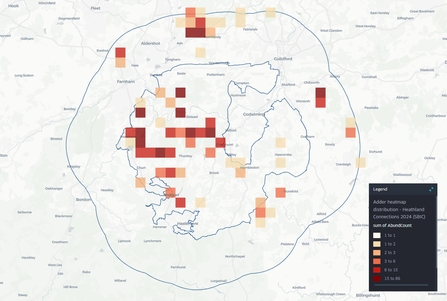
Data sourced from SBIC
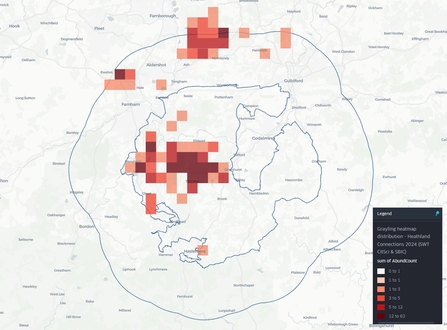
Data sourced from SBIC
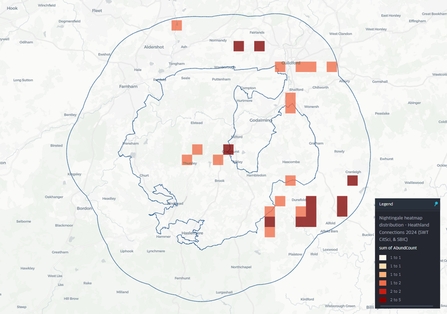
Data sourced from SBIC
Management guides
Download our management guides to learn how you can manage your land for key heathland species, and access funding for habitat improvements.

© Amy Lewis
